
7 Times Ordinary People Decided They Need To Be The Change The World Needed
Politicians and wealthy people may be at the top of the food chain, but society itself would not function without everyday citizens. These are the vital cogs that provide the necessary elbow grease to ensure that everything works as efficiently as possible.
So, for today, we are paying tribute to these unsung heroes through the Working Class History Instagram account. These are historical figures who, in their own way, made an impact on the world around them. Whether or not you’re a history buff, you may learn something new today.
Enjoy reading and don’t forget to upvote your favorites!
#1
On 11 February 1916, Lithuanian-born Jewish anarchist Emma Goldman was arrested in New York City for distributing information on birth control. She was technically charged with breaching the Comstock Act, which banned "obscene" material from the mail or from being transported across state lines.
Goldman's arrest came as she was due to deliver a public lecture on family planning, which was a key concern for working class people. Radicals argued that family planning was essential for working class people to be able to have an acceptable standard of living, and believed that authorities opposed birth control so that there would be an oversupply of labour to keep down wages and fill the army.
Emma Goldman decided to defend herself in court, and used the trial to generate large amounts of publicity for her message. She was eventually convicted, and rather than pay a $100 fine she chose to serve 15 days in prison.
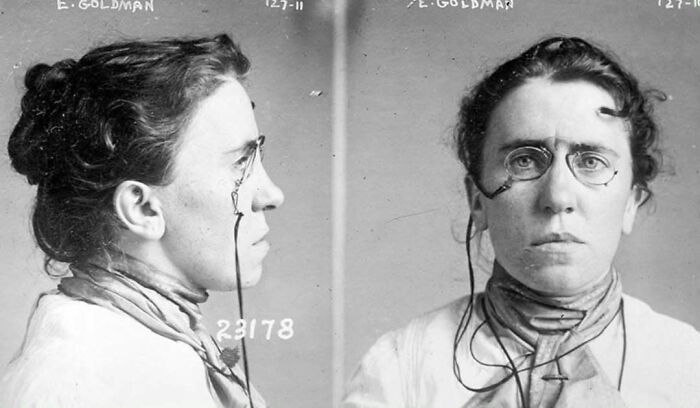
Image credits: workingclasshistory
#2
On 28 June 1969, the Stonewall rebellion began in the early hours. The New York Police Department, as part of its policy of closing gay bars, raided the Stonewall Inn, which had a substantial poor and working class LGBT+ clientele. However, for the first time in the city, rather than submitting to arrest, a crowd began to gather around the police. Inside the bar, gender nonconforming people, trans women and lesbians began resisting invasive body searches. And outside a butch lesbian fought back against police when they arrested her, calling on the crowd that had formed to “do something.” According to some eyewitnesses and her own account, this individual was Stormé DeLarverie, a biracial lesbian and drag performer, who was known as a “guardian of lesbians” in the Village, although this is disputed by others who point to the fact that the only police record for a lesbian arrested that night was of a Marilyn Fowler.
The crowd, which included a significant number of Black, Latine, and white LGBT+ patrons and passersby, then began to physically fight the police, triggering riots that lasted for six days. Those involved in the disturbances included activists like Marsha P. Johnson and John O’Brien, popular folk musician Dave Van Ronk, as well as many others.
In the aftermath, participants and other LGBT+ radicals set up the Gay Liberation Front, which revolutionised the gay rights movement. They organised anniversary protests on June 28 the following year in New York, Los Angeles, San Francisco, and elsewhere. This became the annual Pride celebration that continues to this day all over the world.
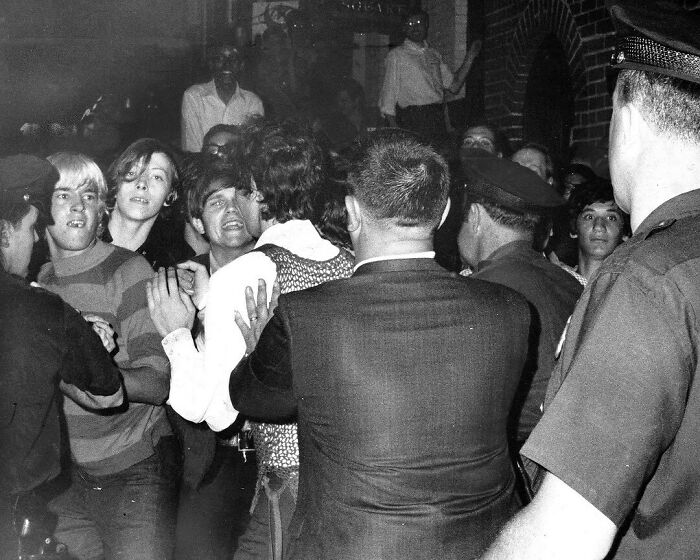
Image credits: workingclasshistory
#3
On 14 October 1977, anti-gay crusader Anita Bryant was "pied" in the face by Thom Higgins, a gay rights activist.
Bryant, who was already well-known as a singer, led Save Our Children, a homophobic campaigning group which successfully overturned legal protections for LGBT+ people in Dade County, Florida.
Bryant had declared about homosexuality: "I will lead such a crusade to stop it as this country has not seen before."
After being pied, Bryant burst into tears and began praying.
Bryant was also brand ambassador for Florida orange juice, which then became subjected to a mass boycott campaign. Gay bars replaced screwdrivers (vodka and orange juice cocktails) with "Anita Bryants" – made with vodka and apple juice, with the profits donated to the campaign.
Bryant's lucrative orange contract subsequently lapsed and her marriage failed, which caused her to be ostracised by some Christian fundamentalists who did not approve of her divorce.
Later in life, Bryant's homophobic views softened, and she stated she was "more inclined to say live and let live". In 1998, Dade County reintroduced legal protections for LGBT+ people, and efforts by Christian groups to overturn them failed.
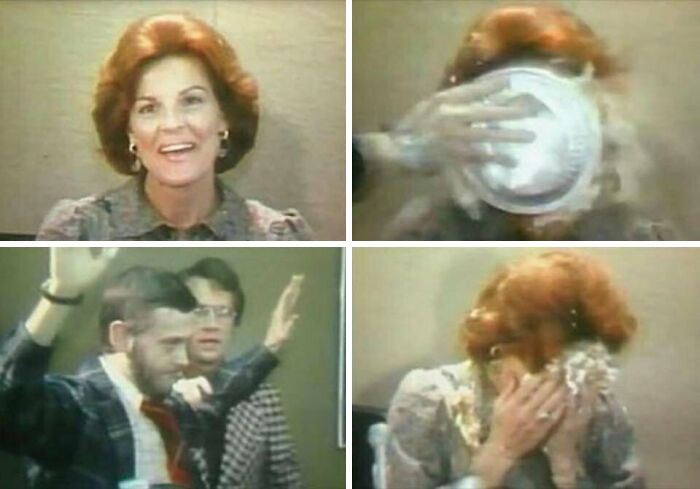
Image credits: workingclasshistory
#4
On 21 April 1856, stonemasons in Melbourne, Australia, went on strike demanding a maximum eight-hour working day – down from 10 hours per day Monday-Friday with eight hours on Saturday.
They marched from their construction site, the Old Quadrangle building at the University of Melbourne, brandishing a banner demanding “8 hours work, 8 hours recreation, 8 hours rest”.
The workers were extremely well organised, and were soon successful in achieving their goal, with no loss of pay, for workers engaged in public works in the city.
They celebrated on Monday 12 May, the Whit Monday holiday, with a parade of nearly 700 people from 19 trades. In 1903, workers in Ballarat, Victoria, erected an 8 hour day monument, commemorating the movement. Pictured: The Melbourne eight-hour banner, 1856
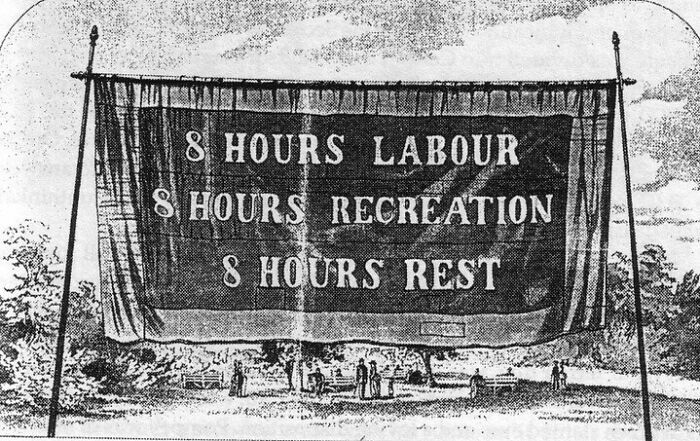
Image credits: workingclasshistory
#5
On 18 December 1974, the radical Danish Solvognen theatre group, all dressed as Santas, provoked a near-riot in a Copenhagen department store.
Against a background of an unemployment crisis, groups of Santas went around on roller skates, others attacked state buildings with pitchforks, others visited the elderly in nursing homes and visited children in schools and passed out people's history books.
The events climaxed when the Santa Claus Army entered the Magasin department store on December 18 and began passing out gifts from the store's shelves for free to shoppers, saying "Merry Christmas! Today, no one has to pay".
They justified their actions saying they were returning gifts to the workers who had made them.
When police arrived, they began arresting the Santas, who cried out: “This is bourgeois justice!”. The children who had been watching started crying – likely the desired result by the activists, to educate the children on the role of the police in capitalist society.
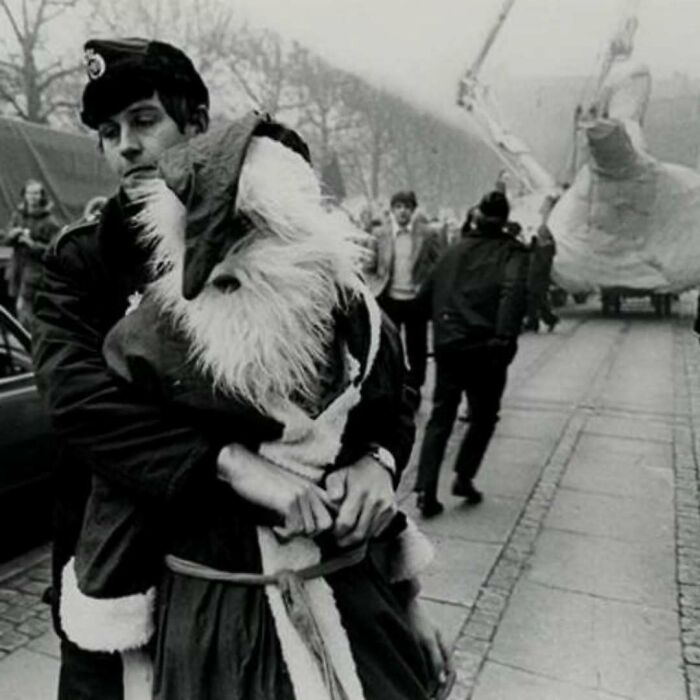
Image credits: workingclasshistory
#6
On 17 May 1966, Vassilis Palaiokostas, “the Greek Robin Hood,” was born in the mountain village of Moschofito, Greece.
In the 1990s-2000s he became famous for robbing the rich and handing his takings to the poor — former comrade Kostas Samaras remembers “he and his brother Nikos would stop the car and hand robbery money to immigrants in the street.”
Palaiokostas has been linked to some of the most audacious illegalism in Greek history, including the 1992 Kalambaka robbery (the country’s biggest ever bank heist) and pioneering bossnapping with the ransoms of notorious industrialists Alexander Haitoglou in 1995 and George Mylonas in 2008.
He is even more famous however for his series of prison escapes which earned him a police nickname — The Uncatchable. The most extraordinary of these were in 2006 and 2009, when he escaped from Korydallos Prison not once but twice by helicopter, bringing him international renown.
A folk hero among the working classes of his homeland, he is still free, still on the run, with a 1.4 million Euro bounty on his head.
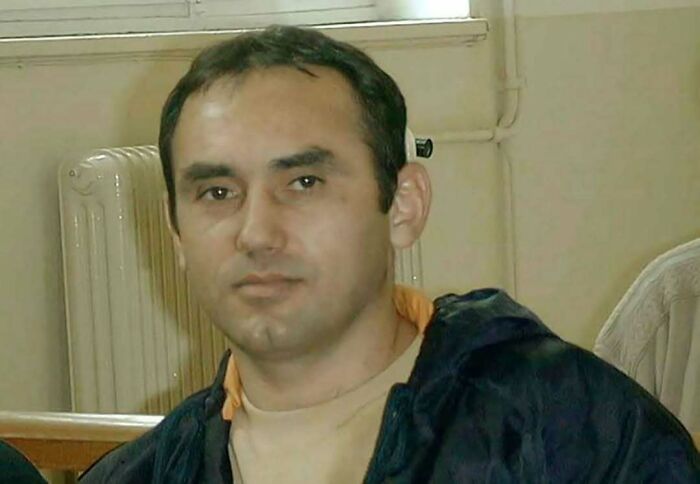
Image credits: workingclasshistory
#7
On this day, 18 October 2019, a series of large-scale protests known as Estallido Social (social outburst) began in Chile, one of the biggest uprisings in the country's history that lasted until March 2020.
While citizen demands focused on social inequality and the ravages of decades of neoliberal policies, the unrest began in the wake of a fare hike on the Santiago Metro on 6 October, after which hundreds of high school students jumped the turnstiles at various stations, calling for fare evasion. After days of clashes between students and police, on 18 October, the right-wing government of Sebastián Piñera announced charges under the state security law, which carries harsh sentences. In response, thousands of people took to the streets, also demanding various improvements to living conditions and an end to abuses by the political and business class. Barricades were built, and acts of arson and looting took place. The next day, the protests spread to all regions of Chile.
State repression was extremely violent and included torture, sexual violence, mutilations and extrajudicial executions, as reports on human rights violations issued by various international organisations found. The actions of the police resulted in 34 deaths, more than 8000 injuries and more than 400 cases of eye mutilation, including Gustavo Gatica and passer-by Fabiola Campillai, who both lost their eyes after direct attacks to the face.
After months of revolt, the demonstrations subsided following an agreement by politicians to organise a referendum on a new constitution, and the outbreak of the Covid-19 pandemic.
In 2020, a plebiscite determined that the vast majority of the country wanted the abolition of the constitution from the dictatorship era. However, since then two proposed constitutions have been rejected and the process for constitutional change suspended.
Several years later, the systemic conditions that provoked the collective discontent remain intact.
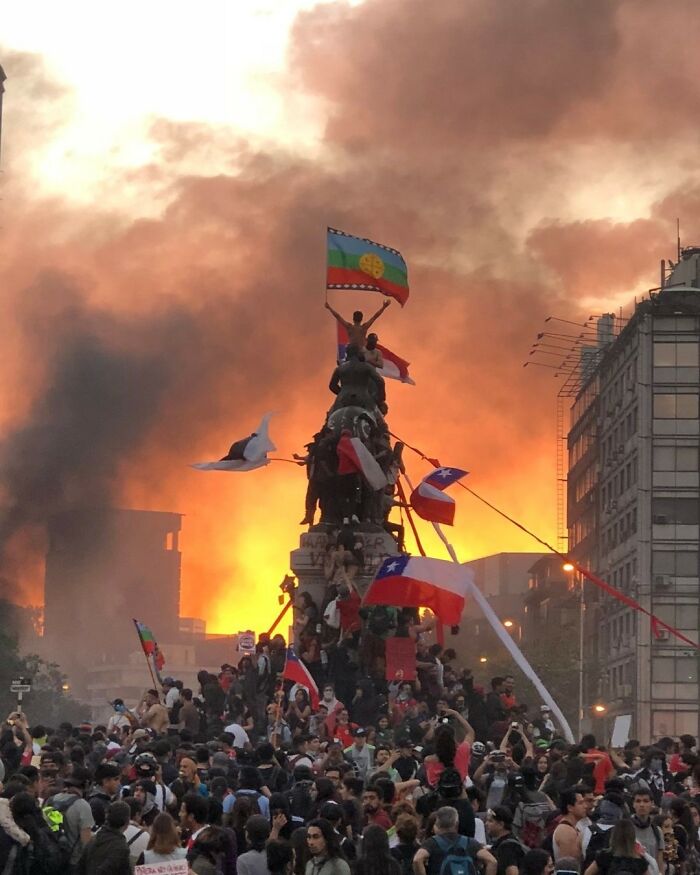
Image credits: workingclasshistory
No comments